

College is a grand adventure, a new stage in the life of a young person. Of course, the important thing to remember about adventures is that they aren’t always safe. While college students won’t have to face the goblins and trolls which vexed Bilbo Baggins in The Hobbit, their safety while at college is often a major concern for their parents.
But how dangerous are college campuses really? Violent crimes and sensationalized stories grab the headlines regularly because they drive attention, but those don’t provide a full picture. In this article we’re going to cover campus safety at top colleges, including a safety rating based on reported crime incidents. We’re going to cover how concerned you should be, and how this may impact your college choices. Let’s dive in.
How Much Crime Takes Place at College
Overall, the number of crimes committed on college campuses has been steadily declining for years, mirroring broader societal trends. You can see this in the data collected by the US Department of Education, which collects these statistics nationwide:
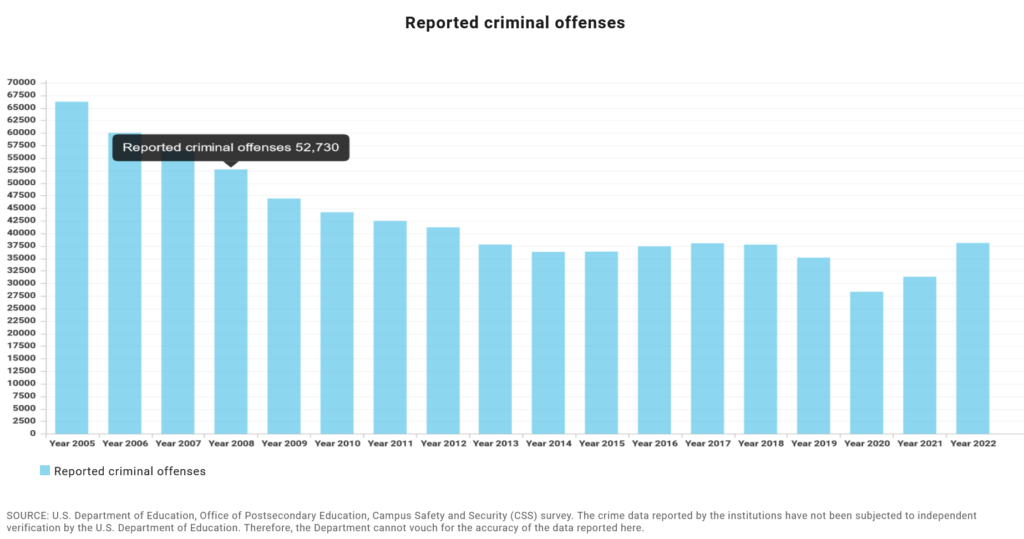
This table does not differentiate crimes by source, but if you want to investigate their data further, you can find it here. Generally, crime has been declining across all categories over the period surveyed. This includes violent crimes such as assault, and property crimes such as burglary and robbery.
This does not mean all colleges are created equal, and some situations are worse than others. Generally, crimes on college campuses fall into two distinct categories, with different risk factors.
Neighborhood Crimes
These often grab headlines, and are a major cause of concern. It is true that some colleges are in less savory neighborhoods; we’ve all heard of Yale and UChicago and how they need many campus police to help protect students from the neighborhood the schools are situated in. These are the crimes which vary most by college, and which you can best control for through college choice.
On-Campus Crimes
These are crimes perpetrated by students themselves, from the drunken antics of overexcited sports fans to more serious crimes, up to and including sexual violence. The neighborhood around colleges matters less for these crimes, as the students themselves are the source of trouble. This does not mean that college students are all criminals, far from it, but there are bad actors in any population, and students themselves do make an impact on reported crimes.
Ranking Campus Safety
How then should we rank campus safety? In this case, we are primarily evaluating the neighborhoods colleges are situated in, though crimes reported on campus factor in as well. Note, however, that high reports of on campus crime do not mean necessarily that more crime occurs there, but merely that a college may have a better and more supportive reporting infrastructure.
| University | City Safety Ranking | Crime as % of Undergrad |
| Boston College | C | .17% |
| Boston University | C | .29% |
| Brown | C- | .73% |
| Carnegie Mellon | C- | .39% |
| Case Western | C- | .22% |
| Columbia | C- | 1.32% |
| Cornell | C+ | .6% |
| Dartmouth | A- | .9% |
| Duke | C- | 2.0% |
| Emory | C- | 1.17% |
| Georgetown | D+ | 1.54% |
| Harvard | C | 1.84% |
| Johns Hopkins | D- | .74% |
| MIT | C | .67% |
| New York University | C- | .05% |
| Northeastern | C | .18% |
| Northwestern | D+ | .53% |
| Notre Dame | D+ | 1.14% |
| Princeton | B+ | 2.27% |
| Rice | C- | 1.22% |
| Stanford | B- | 2.63% |
| Tufts | C | .23% |
| Tulane | D- | .53% |
| UC Berkeley | C- | .32% |
| UCLA | C- | .74% |
| UC San Diego | C | .63% |
| UC Santa Barbara | C+ | .42% |
| UNC Chapel Hill | C+ | .45% |
| UChicago | D+ | .66% |
| University of Michigan | B- | .24% |
| UPenn | D | .53% |
| University of Virginia | C | .43% |
| UT Austin | C | .28% |
| Vanderbilt | C- | 1.01% |
| Washington University of St Louis | D- | .53% |
| Yale | C- | 1.44% |
Our grades for safety are based off of FBI crime data. This is for the city surrounding the college, not just the college itself. The crime as percent of undergrad is the approximate proportion of undergraduate students at a university who are impacted by crime each year.
So What Does This Mean?
The first thing to note is that the safety of a college’s environs doesn’t correlate much at all with how safe it is for students. Nor can we see much of a pattern in what kind of environs they are, and how safe it is for students on campus. College towns, big cities, and rural areas are all very different environments, but one is not inherently safer than another for college students.
In some ways, this is quite reassuring; even schools that are in less savory areas are still quite safe for their students to attend. It also shows how hard it is to draw conclusions about safety just from where a school is located.
A final note is that the size and prestige of a school don’t correlate with safety much at all from what we’ve seen. A school with more resources may be able to invest more in safety, but this does not always pay dividends. Note also that some schools crack down on and criminalize behaviour that others punish. Harvard does not condone underage drinking of course, but they may turn a blind eye to it, while there are some schools which crack down much harder, and thus generate far more criminal incidents involving students.
What this data tells us more generally is that college is always going to be less than perfectly safe. Colleges invest a lot of money into security and policies to protect students, but the world is an imperfect and dangerous place, and for many students college is their first real taste of this phenomenon.
Colleges give safety presentations to students during orientation, to let them know what supports and services are available, and preparing for the neighborhood around a college is part of the transition. This can be something of a culture shock, especially when students want to move out of on-campus housing. However, college is still in general a secure environment, and universities want students to feel safe during their four years on and around campus.
Should This Impact Your College List?
Safety is a concern for parents and students alike, but whether or not safety concerns should impact where you decide to apply or attend is up to you. Safety is merely another factor to take into consideration when deciding which college and campus will fit you best, and best serve your needs.
Students mature at different rates, and have differing abilities to handle themselves. Some graduate high school full of personal and situational awareness, and able to navigate the world around them with open eyes. Others may need a few more years to get the full measure of the world, and participate in it safely.
There is no shame in being somewhat naive about the world as a high school graduate; indeed, it means your parents did a good job in raising you, and helped you avoid many of the struggles of life. It can make for a rough transition to college in some cases, especially when the college in question is rougher around the edges than the high school environment you are used to.
In these cases, smaller and more suburban and rural colleges can be a better choice. College towns are not definitively safer than major cities, but their problems tend to be more self-contained within the student body itself, as the school and town are close to one and the same. This allows students to step outside the safe boundaries of their former environment, without straying too far from what they have known.
Final Thoughts
Safety on campus is just one of many concerns parents have about sending their students off to college, and it’s one we find ourselves discussing regularly. We hope that this article has proven enlightening, showing that colleges are, on the whole, quite safe, and just how seriously they take the safety of their students.
Of course, safety is just one factor among many to consider when researching and evaluating colleges. Doing this for a full college list can be quite difficult, especially with all the other demands students have on their time. If you are looking for help with this research, or with building the right college list for you, schedule a free consultation with us today. We have a long experience working with students to make their lives easier, and are always happy to hear from you.