

Yale is a popular and well regarded university, sitting next to Harvard in the storied pantheon of America’s top colleges. It is unsurprisingly popular among students because of this, receiving a mountain of applications each year. This in turn leads to a ludicrously low acceptance rate, around 4.6% this past admissions cycle. For every hundred students who apply, fewer than five get in. There are options outside of pure acceptance and rejection however. Every year, Yale waitlists students as well, and this is where things get messy. Waitlisted students aren’t in, but they aren’t fully rejected yet either, and a chance remains that they may attend Yale. In this article, we’re going to examine how Yale’s waitlist works, your chances of getting in if you are waitlisted, and how you can maximize those odds. Let’s jump right in!
How Yale’s Waitlist Works
Yale doesn’t release a ton of information about their waitlist or how it works, but there are some things we know for certain. The first, and most important, is that their waitlist is unranked. That is to say that all students on the waitlist are judged the same, and there isn’t a set order in which they are admitted off of the waitlist.
Thai makes sense; Yale uses holistic admissions, judging each student as an individual, and weighing how they will fit into and contribute to the class they are building. They do the same when evaluating students on the waitlist. We don’t know exactly how these reviews go, but we’re fairly certain they parallel the process Yale uses throughout admissions.
When admitting students off the waitlist, Yale is looking to fill holes in their incoming class based on students choosing to attend elsewhere. Thus, if all the engineering students they admitted picked other schools, they would turn to the waitlist to admit a new crop. It is rarely this focused, but that’s the essence of how the process works.
Yale generally only sends out waitlist acceptances after May 1, though we believe they begin assessing students before that. They do request admitted students reply early with whether or not they are attending out of concern for those students who are waitlisted, which does indicate that they begin thinking about this early. That said, if you are waitlisted, do not expect to hear back before May 1. How late waitlist acceptances come out is also uncertain, though we do know they try and get them out in a timely fashion.
As part of this, if you have decided which college you are going to enroll in, we encourage you to withdraw your applications to the other schools which admitted you but which you will not attend. They might not be your number one choice, but they likely have plenty of students on their own waitlist, eager to hear back about their own futures.
Your Chances of Acceptance off of Yale’s Waitlist
The most common, and most reasonable, question we get from waitlisted students is what their chances are of getting into the school which waitlisted them. There are some issues with answering this question, however, primarily just how volatile and variable waitlist acceptance rates are.
Colleges generally have fairly stable overall acceptance rates; they admit a similar number of students each year, even as they have been dropping steadily, there are rarely major shakeups (barring things like Covid, which made everything far too chaotic). Waitlists, on the other hand, depend on the choices of hundreds of individual students deciding to attend a school or not, and are thus harder to prognosticate.
To illustrate this, here is a chart showing the waitlist acceptances Yale has had over the past few years. This information comes from Yale’s Common Data Set, which they release each year.
| Year | Students Waitlisted | Students Accepting Place on Waitlist | Students Accepted Off the Waitlist |
| 2024-25 | 773 | 565 | 23 |
| 2023-24 | 1,145 | 899 | 0 |
| 2022-23 | 1,000 | 780 | 9 |
| 2021-22 | 1,030 | 774 | 4 |
What this table shows is both the high debris of variability in how many students are waitlisted and admitted, and that getting in off the waitlist at Yale is often a very long shot. Of course, parsing a table like this can be difficult, so here’s that same information displayed on a graph:
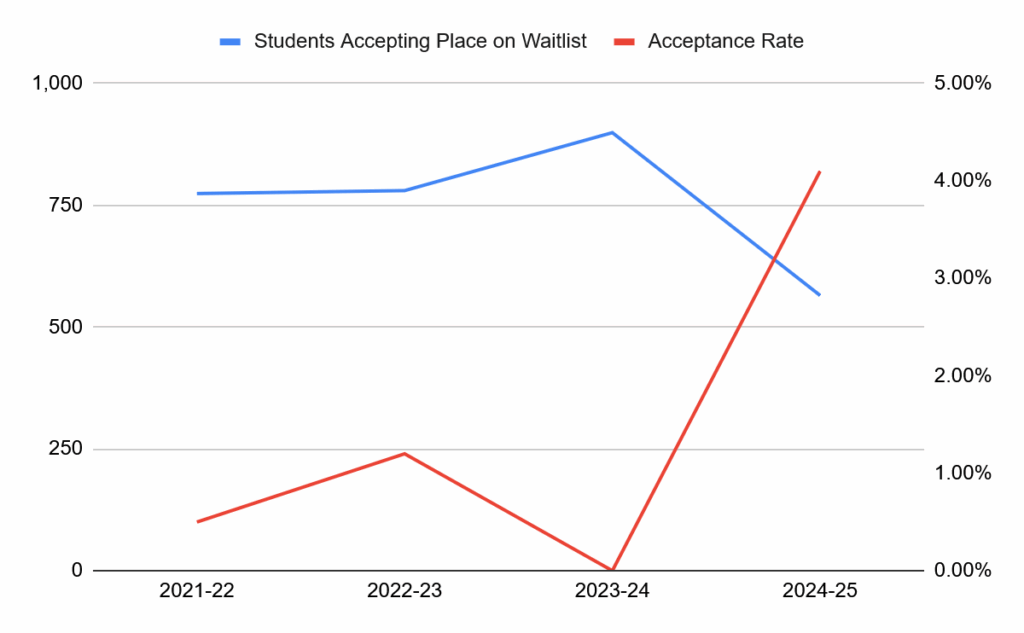
This shows starkly just how variable and how competitive admissions off of Yale’s waitlist can be. It isn’t impossible necessarily, but chances are often quite low, even compared to Yale’s already staggeringly low acceptance rate. Thai is because Yale has a very high yield; most of the admitted students choose to attend, leaving the school little need to turn to the waitlist.
Maximizing Your Chances of Waitlist Acceptance at Yale
The odds of acceptance off of Yale’s waitlist are long, but there are things you can do to improve them. First, and most important, you must accept your place on the waitlist. This isn’t difficult, and may be done through your student portal, but must be taken care of or they won’t consider you at all. We advise doing this early, as Yale likely begins evaluating students on the waitlist well before May 1.
The other thing you can do, and the best way to improve your odds of acceptance off of the waitlist, is to write a letter of continued interest and send it to your regional admissions officer for Yale. Yale does not have an official form for these as some colleges do, but they still accept letters of continued interest, though not other additional supplementary materials (such as portfolio pieces or additional letters of recommendation).
The purpose of these letters is twofold. The first is to state your continued interest in Yale as your top choice school, and to state explicitly that you will attend if they let you in off of the waitlist. Yale uses the waitlist to balance out their class if other students choose to attend elsewhere, and they like assurances that you are committed to their institution.
The other purpose of these letters is to share with admissions officers what you have been up to in the intervening time since you applied originally. This is especially true for significant extracurricular achievements. High grades are nice, but those are expected, they won’t move the needle on admissions.
You should focus on major achievements: new research projects, major awards, winning significant competitions, or new responsibilities at jobs or internships. The goal with this is to show that you are still actively involved with your passions, and to differentiate yourself from other applicants on the waitlist when it comes time to review and decide who gets in.
For each achievement or extracurricular you mention, you should also tie it directly to opportunities you wish to pursue at Yale. If, for instance, you are currently undertaking a research project, you should discuss labs you want to work at on Yale in the same field, or professors whose research interests mirror your own. The point is to show that you and Yale are perfect fits for each other, and that both would benefit greatly if you were admitted.
Final Thoughts
Getting waitlisted isn’t any fun. The college is saying you are fully qualified to attend, but then you aren’t admitted; which is quite disheartening. While this is an unenviable thing to deal with, we hope that this article has demonstrated that getting waitlisted does not need to be the end of your journey for Yale, and that you may still have a chance of getting in, though it is a small one.
If you are looking for more insights into how the admissions process works, or help on perfecting your applications, to Yale or any other college, then Ivy Scholars can help. Our mentors are masters of the admissions process, well versed in every aspect and wrinkle of what admissions officers are looking for. Schedule a free consultation today to learn more, we’re always happy to hear from you.