

The California Institute of Technology (more commonly just Caltech, because that’s quite a mouthful) is an excellent school, well renowned for their academic excellence and rigor. They are regularly ranked among the nation’s top colleges, and have quite a low acceptance rate, as all top rated colleges do; just 3% of students who applied were admitted last year. Not every student who applies is simply accepted or rejected; those who apply early may be deferred to the regular round, while those who apply in the regular round may end up waitlisted. This is something that causes many students concern, and raises an important question: how likely are you to get in if you’ve been waitlisted by Caltech? In this article, we’re going to explore how Caltech’s waitlist works, and what you should do if you find yourself on it. Let’s jump right in!
How Caltech’s Waitlist Works
Caltech places students on the waitlist during the regular decision round of application reviews. They do not have extensive information on this on their website, but do tell us some important things about how the waitlist operates:
- The waitlist is unranked; all students on the list are on equal footing.
- Review of waitlisted students begins after May 1, and concludes by mid-July.
- Waitlisted students are encouraged to send in supplemental materials to support their applications.
This isn’t a lot of information, but does give us some sense of how Caltech’s waitlist operates. We don’t know exactly what review process they use, but the fact that they do ask for supplemental materials, and do not rank the waitlist, implies they do another round of holistic reviews, where students are evaluated for how well they will fit into the class that Caltech is building.
Caltech is more opaque than many of its peers when it comes to fully breaking down what they want to see from students, but it does seem clear they want the same things in the initial round and in their review of waitlisted students. The same admissions officers review both, and will already be familiar with all of these applicants from the initial round, we suspect this is why they specifically ask students to submit supplemental materials if they’ve been waitlisted.
Your Chances of Getting in off of Caltech’s Waitlist
The most common, and most reasonable, question students have once they’ve been waitlisted is what their chances of getting in are now. This is a very good question, but not an easy one to answer, due to the nature of how waitlists work.
Caltech admits students off of the waitlist when students they had already admitted choose to attend another school. There is no way to control or accurately predict this, though admissions officers try to, leading to a high degree of volatility. Thus, the number of students admitted off of the waitlist can and does change drastically from year to year.
In addition, Caltech is a small school, especially compared to many of its peers. It simply enrolls far fewer students, and correspondingly keeps a far smaller waitlist. This means even a small change in the number of waitlisted students accepted can have a significant impact on their waitlist acceptance rate.
To illustrate this further, here’s the waitlist admissions data from Caltech for the past several years. This data comes from Caltech’s Common Data Set, a collection of data the school releases every year.
| Year | Students Waitlisted | Students Accepting Place on Waitlist | Students Accepted Off the Waitlist |
| 2024-25 | 206 | 171 | 41 |
| 2023-24 | 213 | 199 | 0 |
| 2022-23 | 195 | 167 | 15 |
| 2021-22 | 268 | 213 | 0 |
This illustrates clearly just how volatile the waitlist acceptance rate is at Caltech. While the school puts a relatively consistent number of students on the waitlist, the number of those who end up being admitted is far more variable. Tables are not always the easiest to read however, so here’s that same data on a graph:
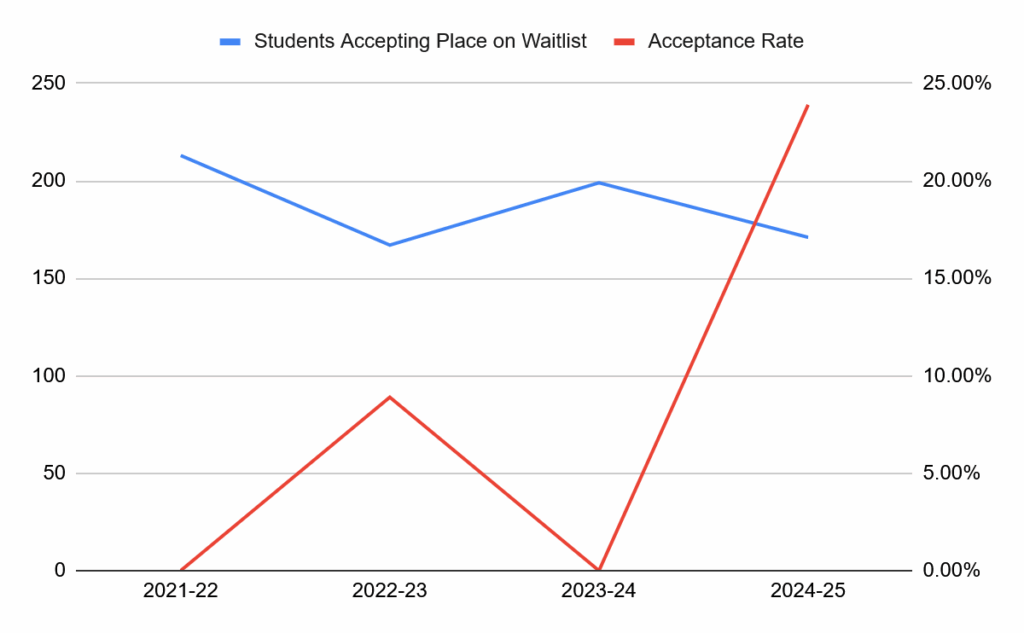
This shows quite clearly the remarkable degree of variance in Caltech’s waitlist acceptance rate. This variability unfortunately makes it impossible to predict what their waitlist acceptance rate will be any given year, or what your specific chances are for getting in off of it.
Improving Your Chances of Getting In Off of Caltech’s Waitlist
It’s difficult to say what your odds are of getting in off of Caltech’s waitlist, but there are certain things you can do to concretely improve those odds. The first, and simplest, is that you need to accept your spot on Caltech’s waitlist. This isn’t hard, but you must do this by April in order to be considered. We advise accepting your spot promptly, to ensure that you don’t forget or miss the deadline.
After this, Caltech specifically encourages waitlisted students to submit supplemental materials. This makes sense; all the students on the waitlist were good enough to get in, but didn’t quite make the initial cut. Supplemental materials are the way to showcase what else you’ve done, and help set you apart from other applicants.
The most important of these is a letter of continued interest. You don’t want to overwhelm admissions officers with added documents and reading, they have plenty of that to do already. Instead, you want to share everything you have accomplished in a single document, one which lays it all out for them in an easily digestible form. There are some exceptions (which we’ll cover later), but this letter is the main thing you should focus on.
You should try to get this letter to Caltech by mid-April, so that they may add it to your file before they begin reviewing waitlisted students. This letter should begin by stating that Caltech remains your top choice, and that you will attend if admitted. Caltech considers demonstrated interest less than other schools, but this is still worth including in this letter.
The bulk of this letter should focus on things you have done and accomplished since you applied originally. You don’t need to mention every high grade, but should instead focus on things which have made a significant impact; new responsibilities at an internship, competitions you entered and won, or major positive changes in an organization you’re head of.
For each experience you list, you want to tie it to an opportunity at Caltech. If you submitted a film to a student film festival, for example, you can talk about a film club at Caltech, and how you want to contribute to that once you’re on campus. The goal of this is to tie your goals and desires to Caltech in a concrete way, to make it seem like the next logical step on your academic journey.
You should conclude this letter by once again reaffirming your desire to attend Caltech, and thanking the admissions officers for their time. You don’t need to be effusive, but a little politeness can go a long way.
Research Supplements
The other form of supplemental material you should consider submitting to Caltech is a research supplement. Caltech is one of the colleges with a specific research supplement they encourage students to complete. If you completed a research project (a major one, not just a class project), and are aiming for publication, and you have not already completed a research supplement for Caltech, then you should fill this out. Here is what they specifically are looking for when hearing about research you have completed.
Final Thoughts
Caltech is a very good school, and it is no surprise that so many students want to apply to it. This in turn makes Caltech’s exceptionally low acceptance rate equally unsurprising, even if it can be disheartening. Getting waitlisted can feel like the end of the world, but we hope that this article has demonstrated that you can still have a chance to attend Caltech, even if you do end up on their waitlist.
If you are looking for help writing your letter of continued interest, or advice on applying to Caltech in the first place, then Ivy Scholars can help. Our mentors are masters of every aspect of college admissions, and we love hearing from students like you. Schedule a free consultation today to learn how we can make your college application journey easier.