

Princeton University is one of the top colleges in the US, regularly topping the various ranking lists. It is understandably popular with applicants, drawn by its prestige and stellar academic reputation. This popularity translates to an equally low acceptance rate, only 4.4% this past admissions cycle. For every hundred students who apply, fewer than five end up getting into Princeton. Not everyone is just rejected though; some students are instead placed on a waitlist. These students are ones Princeton acknowledges as good enough to get in, but didn’t have a space for. While this is a compliment, it is terribly disappointing as well. Getting waitlisted isn’t necessarily the end of your journey to Princeton however, as students do get into the university after getting waitlisted regularly. In this article, we’re going to look at how the waitlist works, what your chances are of getting admitted if you are waitlisted, and how you can best maximize those odds. Let’s jump right in!
Understanding Princeton’s Waitlist
Princeton, as with most universities, is somewhat opaque on the inner workings of their waitlist process, as they tend to be for admissions generally. There are some things we can glean however, based on what information they do make available. The first key piece of data they give us is that their waitlist is unranked.
This means that there is no immediate preference for which students are admitted off the waitlist; theoretically, all waitlisted students begin on an even playing field. This makes sense; Princeton uses holistic admissions for their admissions already, and they will likely do the same for waitlisted students, seeing which will fit best into the particular holes which open up in their incoming class.
Princeton is trying to build a whole greater than the sum of its parts when admitting students. When those students choose to attend other institutions instead, that leaves holes in this image. Admissions officers turn to the waitlist to fill these gaps. For example, if all of their admitted computer science students chose to attend MIT instead, Princeton would turn to the waitlist and admit a bunch of CS students to fill those empty seats. It is, of course, rarely this straightforward, but that is the logic admissions officers employ when deciding who to admit off of the waitlist.
Your Chances of Acceptance Off of Princeton’s Waitlist
This same logic makes determining how likely you are to get accepted off of Princeton’s waitlist rather challenging. Nobody, not us, not even Princeton, can precisely predict how many admitted students will choose to attend other schools. For this reason, there’s no way of knowing how many seats will be available, and how much Princeton will need to turn to the waitlist.
To illustrate this more clearly, let’s look at data from past years on how many students Princeton admitted off of the waitlist. This information comes to us from the Common Data Set, a set of statistics that Princeton releases each year.
| Year | Students Waitlisted | Students Accepting Place on Waitlist | Students Accepted Off the Waitlist |
| 2024-25 | 1,734 | 1,396 | 40 |
| 2023-24 | 1,302 | 1,032 | 52 |
| 2022-23 | 1,710 | 1,348 | 0 |
| 2021-22 | 1,265 | 1,000 | 150 |
These numbers vary quite a bit year to year, with no noticeable pattern. Overall acceptance rates tend to be a bit more predictable, if variable in their own right, but acceptances off of the waitlist are far more finicky, and much harder to predict. This means knowing your own chance of acceptance off of this list is almost impossible. To further illustrate this, and for ease of reading, here’s a graph of the same information, as those are often easier to parse.
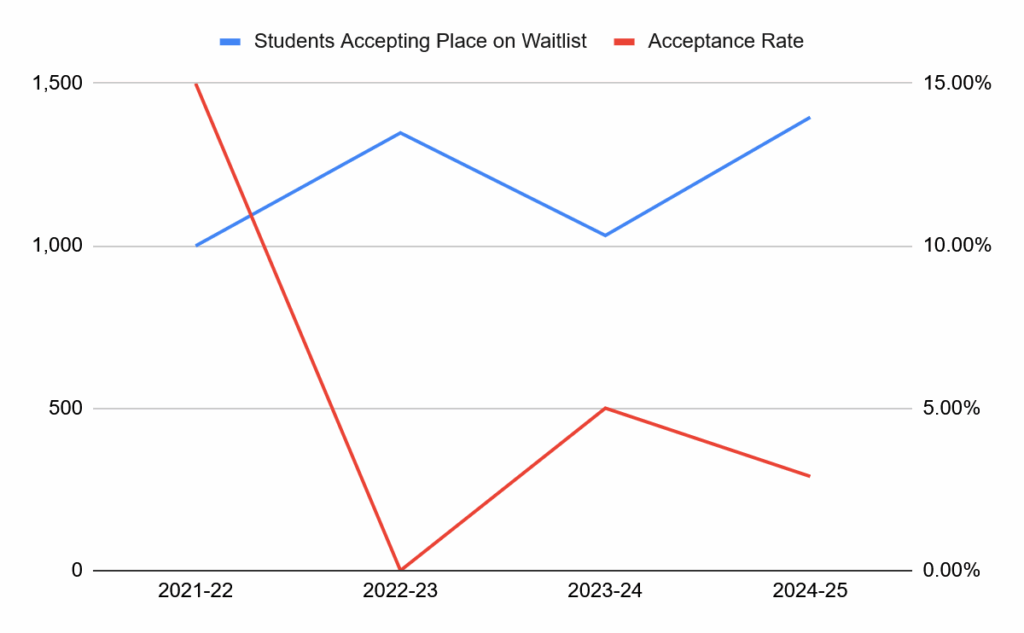
This graph shows starkly how variable waitlist acceptances can be. What is interesting is how much the number of students Princeton puts on the waitlist fluctuates each year, especially compared to some other schools. Many colleges place the same number on the waitlist each year (or close), but Princeton showed a high degree of volatility in this over the past few years.
Notably, the number of students who were waitlisted by Princeton showed no correlation to the number of waitlisted students eventually admitted by Princeton. This indicates that admissions officers at Princeton are no better at predicting the number of waitlist acceptances than the rest of us, even with all the information we don’t see. The one thing we can say for sure, is that getting in off of the waitlist at Princeton is always going to be competitive.
How to Get Admitted Off of Princeton’s Waitlist
There is no way to guarantee admittance off of Princeton’s waitlist, just as there is no way to guarantee acceptance when you originally apply. There are, however, definitely ways to improve your odds. The first, and most important thing to do is accept your spot on Princeton’s waitlist.
We don’t know exactly when Princeton begins looking at students on their waitlist, but we do advise responding promptly if you do find yourself waitlisted. This prevents you from forgetting, and must be done if you want a chance of getting in off of the waitlist at all.
The other thing you can and should do is send Princeton a letter of continued interest. They do not actively welcome or encourage these like some schools, but they do accept them, and they can improve your chances of getting in off of the waitlist if they are done well. These letters should be sent to your regional admissions officer, as they are the ones who will be most familiar with your application.
The purpose of these letters is twofold: first to express your continued desire to attend Princeton, and second to update admissions officers on everything you’ve been up to since you submitted your original application.
On the first point, you want to begin your letter first with standard pleasantries, and then by directly stating that Princeton remains your top choice, and that you will attend if you are admitted (even if this isn’t necessarily true). You don’t need to fill this with over the top praise, but you want to be clear on this point. Schools want students who want them, and the only way they know for sure how interested you are in attending is if you say so directly.
Once you have done this, you should update admissions officers on any major developments to your candidacy. This isn’t the place to highlight every stellar grade; that is what’s expected of you already. Instead, you should focus on what you have done in your extracurriculars and other activities, new milestones reached and accomplishments that showcase the heights of your abilities.
You should focus on a few high-impact accomplishments; a major award or scholarship won, a new research project, new responsibilities at a job or the completion of a major undertaking at an internship. The goal is to showcase both that you are still actively involved in pursuing your interests and passions, and to highlight the heights of your achievement, things which can help differentiate your application from the others in the waitlisted pool.
Each of these accomplishments should further be tied to an opportunity at Princeton. If you won a debate tournament, for example, you should then also discuss how you want to join a particular debate club or society at Princeton. This helps solidify your desire to attend the school, and showcases how you will benefit campus by your presence.
Final Thoughts
Princeton is a great college, and like all great colleges, it is increasingly difficult to get into, seemingly more competitive every year. This can make it feel impossible to get in, and getting waitlisted, being so close and yet so far, can feel terribly crushing. We hope this article has brought new insight into how the waitlist process works, and what your odds of acceptance are if you find yourself waitlisted by Princeton.
There are many intricacies and oddities in the admissions process, which confound students every year. We hope this article has helped resolve one of these; one of our goals is to help students approach the application process with confidence. If you are dealing with questions or stress in your application process, or want advice on your Princeton application, then Ivy Scholars can help. Schedule a free consultation today to learn more about how we can make your life easier.