
Washington University in St. Louis (more commonly either WashU or WUSTL because that’s a real mouthful of a name) is one of the nation’s top colleges, though it isn’t quite as famous as the Ivy League schools. As a top college, it understandably has a rather low acceptance rate, just 12% this past admissions cycle; around one in ten students who apply get into WashU. Of course, there are places that exist between just acceptance and rejection, most notably the waitlist. These are students who are good enough to attend WashU, but who did not make the final cut for acceptance for one reason or another. You can still get into WashU if you’re been waitlisted, and in this article, we’re going to explore how exactly the whole process works. Let’s jump right in!
How WashU’s Waitlist Works
Waitlisted students at WashU are placed into a general pool. When students make their final decisions on where to attend, WashU sometimes ends up with fewer students committed to attend than they have empty seats, due to students getting into multiple schools and choosing a different one to enroll at. When this happens, WashU turns to the waitlist to make up the gaps.
Applicants on the waitlist are evaluated based on where gaps are; for example if a large number of students interested in business choose to attend another school, admissions officers will be looking for more business students to replace them. WashU looks to build a balanced class; most of the time it’s not this straightforward, but the major and program you’ve applied for can have a major impact on your waitlist admissions chances.
It can happen in the reverse as well; perhaps every CS major admitted by WashU has decided to enroll. In this instance, no CS majors would be admitted off of the waitlist, there simply wouldn’t be any room for them at the school. It is impossible to predict how this will go, which makes prognosticating waitlist acceptances difficult.
It is uncertain when students begin getting informed as to whether or not they are admitted off the waitlist. We do know that all waitlist decisions are made by June 30, according to the school themselves. Most colleges only begin making decisions after May 1, but a few do send out some waitlist acceptances early. We do advise (and so does WashU), to submit a deposit to another school which admitted you by the May 1 decision deadline, to ensure you will be attending college somewhere.
Your Chances of Acceptance Off of WashU’s Waitlist
The most common question we get from waitlisted students, and the most reasonable one to ask, is what your chance of acceptance is if you’ve been put on WashU’s waitlist. This is a good question, but as so often happens with good questions, there isn’t really a good answer.
This is because waitlist acceptance rates are highly volatile, and WashU is no exception to this trend. To illustrate this point, here’s a table with the number of waitlisted students, and the number of those accepted over the past few admissions cycles.
| Year | Students Waitlisted | Students Accepting Place on Waitlist | Students Accepted Off the Waitlist |
| 2024-25 | Not released | 2,658 | 210 |
| 2023-24 | Not released | 2,713 | 200 |
| 2022-23 | Not released | 3,981 | 0 |
| 2021-22 | Not released | 2,696 | 915 |
Note that WashU never releases how many students they choose to place on the waitlist; we don’t know why this is; they just don’t. Other information comes from WashU’s Common Data Set, released annually. Based on peer schools, we estimate that around 75% of waitlisted students choose to remain on the waitlist, but this is only a guess, and we cannot say for certain unless and until WashU decides to release that information.
It’s quite clear just from this how exceptionally variable waitlist acceptances can be at WashU (which is true of every university which makes use of a waitlist as well). To further illustrate this, however, here’s a chart showing the same information.
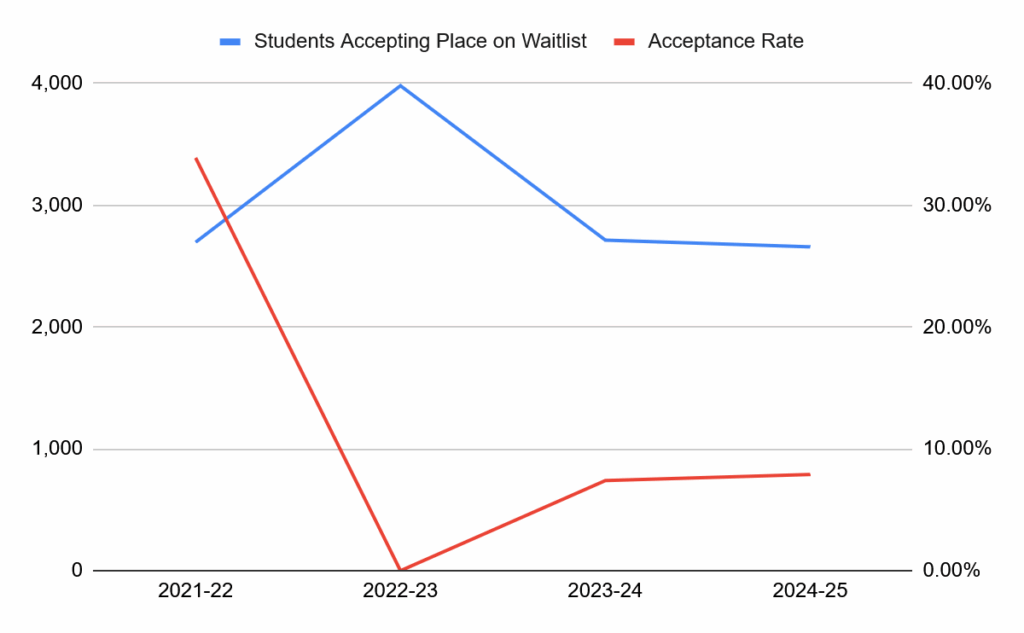
This chart illustrates the same data, but much more visually and drastically. The radical shift between 2021-22 and 2022-23 is the most notable, but also explains itself. WashU had to let in far more students off the waitlist than anticipated this year, panicked, and overcorrected. This led to far more students on the waitlist, and far fewer of them getting admitted.
This can happen, and is hard for admissions officers, or anyone else, to foresee. It does illustrate just how chaotic waitlist acceptance rates can be, and how not even those with the most information, admissions officers, are able to make solid predictions from year to year.
What to do if You’ve Been Waitlisted by WashU
The data above shows us that getting waitlisted isn’t necessarily the end of the road for your ambitions at WashU; most years students are admitted off the waitlist, often even a reasonable number of them. The question then becomes what you specifically can do to ensure that you are one of these lucky students.
The first, and most important thing you must do is accept your spot on the waitlist. You won’t be considered for waitlist admissions at all unless you do. WashU requires you do this earlier than many other schools, with a deadline of April 15. We advise accepting your place as soon as you are waitlisted if you are still interested in attending WashU, just to ensure it doesn’t slip your mind.
This is the bare minimum to get considered, but there are other active steps you can take to improve your chances of getting in off of the waitlist. The most important of these is updating admissions officers on what you’ve been up to in the interim since you applied through an update letter.
WashU officially welcomes these letters; they ask they be uploaded through your student portal, which you get access to once you have applied. Based on their phrasing, they will accept more than one update; we generally advise submitting only a single update letter, generally in March. You don’t want to overwhelm admissions officers with minor updates, they already have a lot of work to do.
The purpose of these letters is to share what you have accomplished in recent months, and in so doing give admissions officers more insight into your capabilities. While your choice of major is a significant factor in admissions off the waitlist, more impressive achievements can help differentiate you from the few thousand other students on the list with you.
When writing one of these letters, you should always begin by stating that WashU is and remains your top choice school. WashU is less popular than a number of other top colleges, and like everyone else, they want to admit students who actively want to attend their school.
You should then go through your major accomplishments. You shouldn’t cover every aced test, but rather focus on major accomplishments you’ve done, especially in your extracurriculars. Here’s some examples of what that looks like:
- Winning a major competition, such as a debate tournament or a fencing tournament.
- Publishing or presenting original research, if you do so through a peer reviewed journal or conference.
- Taking on new responsibilities or completing a major project in an internship or other organization.
For each of these, you want to tie your interests and accomplishments to opportunities at WashU. This is the best way to demonstrate your continued interest in the school, and is far more effective than simply showering them with effusive praise. By tying your interests to their offerings, you showcase how you and the school are perfect fits for each other, and how you will actively contribute to their community.
You should end these letters by affirming that you will attend if you are admitted. This doesn’t need to be extensive, or even necessarily true, but you should say it, and say it in a way where admissions officers will believe it.
Final Thoughts
WashU is a great school, even if it isn’t in the Ivy League. Tens of thousands of students apply each year, and they do so for good reason. We hope this article has helped you understand what WashU’s waitlist is, and how exactly it operates. It’s not a fun thing to get waitlisted, to be told that even more work is required on your college journey, but it’s not the end of the world either.
If you are looking for advice, be it on your original round of applications or on writing a letter of continued interest if you’ve been waitlisted, then Ivy Scholars can help. Our mentors have a depth of experience on every aspect of the admissions process, and are always ready to help you with your questions. Schedule a free consultation today to learn more, we’d love to hear from you.